Cyprus Cuisine: Journey Through the World’s Healthiest Diet, Infused with Vibrant Spices, Fresh Herbs, and Tangy Citrus Twists

Cypriot cuisine is very diverse to begin with. That being said, I think most tourists don’t even get to try one local dish during their visit to North Cyprus. I believe they are missing out big time.
The high-end hotels with all-inclusive packages often provide the visitor with easy access to the beach, leisurely services, entertainment, and a variety of food options. Thus, tourists often don’t feel the need to explore further beyond the hotel resort.

However, as a Cypriot, I believe Cyprus has a lot more to offer: a rich history with various interesting landmarks to show for, vibrant nature and a diverse local cuisine being the top ones.
The easiest way for a tourist to sample some of the local dishes is to visit a local “meyhane”. During a single meal, you’ll have the opportunity to try a variety of different local dishes and drinks, as you’ll be served bite-sized portions over a few hours.

While other local dishes may not be as obvious to spot as meyhanes, a quick online search should suffice in aiding one’s research if you know what you’re looking for. I will share my top picks in this article, which will hopefully help guide you in the right direction.
Mediterranean Diet Forms the Basis of North Cyprus Cuisine
The diet in North Cyprus is, for the most part, typical of the Mediterranean, with slight influences from the East. Our climate and topography are typical of the Mediterranean; hence, our food is historically based on the regional vegetation that grows naturally and is in abundance. The Eastern-influenced part of our diet, I think, is fairly new, and is comprised of a wider consumption of red meat and the addition of some spices to a wide selection of herbs that were already in use.

What nature gives is what our diet’s building blocks are made of, these form the base of our cuisine, which has been shaped and garnished further over time with the introduction of different flavors. As a result, our food is rich in olive oil, citrus, plant-based dishes, mushrooms, legumes and fish. It has been long proven that the Mediterranean diet is one of the healthiest diets in the world, supported by many studies and research published by the best institutions in the world, such as Harvard University.

Olive and carob trees are often found in the wild. I was fortunate enough to inherit olive farms from my grandfather, where some trees are as old as 600 years old with massive trunks, that are truly admirable. I am lucky to have liquid gold of my own, fresh from the farm. However, there’s no need to worry if you don’t have your own supply, as finding fresh, organic olive oil in Cyprus is as simple as visiting the local market.

The wild plants are still in use in the majority of the local’s diet. It is still a family tradition to go on wild plant and mushroom hunting and gathering and it makes up for a nice weekend outdoor activity for families. Locals love to collect and display their prized “gavcar” mushrooms. There are dedicated social media groups to share pictures of these mushrooms, some as large as a football. Everyone keeps the location of their treasured mushroom findings a secret, so they can come back next time for more of it. These usually grow around the tree trunks and should be only collected with appropriate baskets so the spores keep getting distributed around to ensure their species are sustained.

There are numerous plant-based vegetables that grow wild, such as wild asparagus (ayrelli), mallow (gomec), hosdez otu, wild spinach, yumurta otu, and purslane (semiz otu). Many more species are waiting to be explored. Some, like mallow, can make a delicious meal, while others, such as sage, are perfect for brewing tea. Kappari leaves are commonly used to make pickles, and certain species, like wild oregano, are employed for seasoning.

We are also fortunate to have easy access to a wide range of fresh greens, herbs, vegetables, fruits, olive oil, cheese, jams, and pickles in our supermarkets, often sourced directly from local farms. These clean and fresh ingredients are readily available at affordable prices. Additionally, we have dedicated markets for fresh produce-only, where daily harvests are brought in from nearby villages to be sold. These markets can be found in every town, with some towns even hosting more than one, depending on their size. They are easily identifiable while driving, as the colorful open displays of fresh vegetables and fruits catch your eye.

Furthermore, we have a once-a-week open bazaar (food market) set up in each town on different days of the week, where prices tend to be even more economical. A savvy shopper may choose to visit either early in the morning for the freshest produce or later in the afternoon for discounted items, as vendors often offer heavy discounts towards the end of the day to sell everything off.

Feasting on Occasions: Food and Social Life
Cuisine and culture are deeply intertwined. Our treasured recipes are passed down through generations and are considered a significant part of our national heritage. Like many others, Cypriot social life often revolves around some form of communal dining. All types of celebrations involve food, and the principle of “the more, the merrier” always applies. We often say “artsin eksilmesin,” which translates to preferring a surplus rather than not having enough.

Both male and female members of the population unite over this tradition. Unlike many other patriarchal societies, the main gathering, known as a “mangal” where barbecue is the centerpiece, is often prepared and cooked by the male members in Cyprus. To simply call it a barbecue would be an injustice, as it involves various forms of koftes (seasoned meatballs), Cypriot sausages (such as sheftalia and pastirma), and seasoned meats, often prepared a day in advance. This form of barbecue also includes drinks and mezzes – tapas-style side dishes and salads to be shared.

It’s common to have one of these gatherings every weekend, often on Sundays. However, larger groups gather for more special occasions like religious holidays, New Year’s, Labor Day, birthdays, Mother’s Day, and more. Anything can be an excuse to arrange a mangal get-together in Cyprus.
Hospitality is a significant aspect of our culture, and the most esteemed way to demonstrate it is through feeding guests, even resorting to force-feeding if necessary (just kidding, or maybe not).

A house visit will invariably include a round of coffee service and often evolve into a shared meal. Cypriots are taught to share from a very young age, and they genuinely enjoy it. Gathering around long tables with dozens of chairs with loved ones for hours is what most Cypriots find fulfilling and wholesome.
Rituals Around Eating in Cyprus
Cypriots have a few rituals around eating. I’ll share a few that come to mind. The top one is the local coffee tradition, encapsulated in the saying “bir kahvenin kırk yıl hatrı vardır,” which translates to “a cup of coffee commits one to forty years of kindness.” While it signifies a significant commitment, locals enjoy coffee daily without taking it too literally. Coffee is often offered after a meal. Zivania, dubbed fire brandy, is another local drink offered post-meal, which I personally do not recommend as it is very strong and has a distinct aftertaste. Try and see for yourself.

Coffee may also be offered during house visits in between or after meal times during smaller gatherings. In such cases, it’s also customary to offer some local Majuns. More on the local coffee tradition will follow shortly. Let me delve into the local majuns briefly.

Majuns are candied fruits or fruit peels that are preserved in sugar. The most common types are unripe whole walnuts, watermelon skins, pergamot skins, and quince. Traditionally, these are served with a hand-embroidered napkin, often crafted by the lady of the house, and eaten with a two-pronged fork. As they are too sweet to consume directly, guests are often provided with a cup of water. The majun can be soaked in the water for a bit, then eaten, followed by drinking the water afterward. This process both sweetens the water and enhances the fruit’s flavor from the majun, which might otherwise be masked by the sweetness.

The jars containing majuns are often infused with other flavorings, such as clove sticks, adding an extra layer of flavor. Traditionally, these treats were displayed in the guest living room, atop a hand-carved heavy wood console or a showcase, which today would be classified as antiques.

The finest lefkara trays, which are made of silk lace embroidery authentic to Cyprus, will also be on display. Fun fact about lefkara work is that many believe Leonardo da Vinci‘s visit to Cyprus in 1481 A.D. had a strong influence on his work, where motifs of lefkara can be seen repeatedly in some of his work. The guest could pick and choose the flavor of majun to their liking. There will also be refreshing ‘kolonya’ often infused with flower aromas, along with the majun displays acting somewhat as hand sanitizer.


The above-mentioned traditions are the most prominent ones, and it is highly likely that you will come across some during your visit to Cyprus. Some other traditions that are harder to come by these days include escargot mezzes, offal dishes, and the custom of votive offering of animal sacrifice for celebratory occasions, which is of Shaman origin.
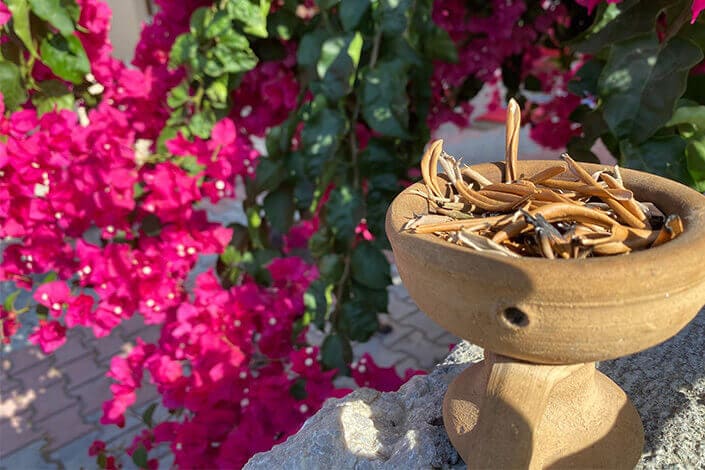
At the conclusion of the hosting, a piece of dry olive branch with leaves would be burned for good luck, and its’ smoke is embraced for protection from the evil eye. It is a similar tradition to burning sage.

As the guest departs, a bucket of water is poured behind them, symbolizing the hope that they will return soon, flowing back like water. This gesture signifies the host’s desire to welcome the guest back again in the near future.
Coffee Culture in Cyprus
Casual gatherings often revolve around coffee, served in tiny cups named ‘fincan’ traditionally cooked in a ‘cezve’ made from copper, which contributed to Cyprus’s name from Cyprium in Latin due to its abundance. Today, we have abandoned the everyday use of copper cups cooked over coal for more modern and fast electrical coffee machines. The local coffee leaves behind a residue of crushed beans called ‘telve’, which locals love to use for entertainment in the form of fortune telling, known as ‘kahve fali’. Surprisingly, we even have apps for this today.

After finishing your coffee, you cover the tiny cup with its matching plate, swirl it a little, and then flip it upside down in the direction towards yourself. Then you let it cool. Once it reaches room temperature, you can start interpreting stories from the visuals in the residue or simply send pictures to one of the mobile apps created for this purpose. I can’t vouch for the accuracy, but it makes for a fun time with friends.
The origin of this coffee is highly debated, with various cultures such as Cypriot, Greek, Turkish, and Moroccan, among many others, staking a claim to it. However, all of these nations were once part of the Ottoman Empire, which played a significant role in spreading the trading of these valuable beans. As a result, many nations today share similar coffee traditions, reflecting the historical and cultural exchange facilitated by the Ottoman Empire.

Coffee also plays a central role in not-so-casual gatherings, such as discussions of marriage matters, namely ‘kız isteme’ which is the formal proposal for marriage, or asking the father for the lady’s hand in marriage. Traditionally, these matters were discussed over a cup of coffee between the two families. Today, while people often date before deciding to marry, the symbolic coffee meeting still holds ceremonial significance. In older times, if the bride-to-be was not interested in the groom, she would serve him coffee with salt to signal her disinterest. Nowadays, this gesture is often done as a playful joke, testing the groom’s level of interest by how much he tolerates the salty coffee.

Traditionally, the bride displayed her craftsmanship to impress the groom’s family by serving coffee on Lefkara trays, traditional Cypriot silk lace embroidery. These trays were once part of the bride’s ‘ceyiz,’ a collection of handmade laces, linens, and kitchenware prepared by the bride and her family for her new home upon marriage.
Raise a Glass: Cyprus Holds the Guinness World Record for the Oldest Manufactured Wine
Commandaria is a Cyprus-trademarked wine that is produced only in the mountains of Trodos in 14 villages. It holds the Guinness World Record for being the oldest wine in production in the whole World. It is a sweet dessert wine, and was declared “the wine of kings and the king of wines” by Richard the Lionheart when he celebrated his marriage to Berengaria and his overtaking of the Island of Cyprus.

Commandaria holds a special place in the Church as it’s the historic wine used for the Holy Communion. Dating back to 800BC, the crusades in the 12th Century called this delicacy the “Cypriot Nama” believing that the wine had therapeutic qualities. It is made from two unique types of grapes the blue grape mavro blue and the white xynisteri, both are indigenous to Cyprus.

As can be understood, the wine history in Cyprus dates way back, hence various types of grapes have been in production for a long time. During times when grapes were produced in surplus Cypriots found alternative ways to make use of them such as to make ‘sucuk’ which is a grape candy with nut filling that is a chewy delicacy.

Repertoire of Dishes in North Cyprus
Almost every dish in Cypriot cuisine features copious amounts of olive oil and some form of citrus, resulting in unique and flavorful dishes. There are several different methods of preparing dishes, which we categorize our recipes into. The same main ingredient can be cooked in various ways to create different dishes. Some of these categories include dishes with olive oil (“zeytinyağlılar”), dishes with tomato paste (“salçalılar”), soups (“çorbalar”), grilled dishes with seasoning (“kebap”), pastries and pasta types (“hamur işleri ve borekler”), or stuffed dishes (“dolmalar”).

Cypriots have their versions of all these types of dishes, and the methods of cooking can vary slightly from town to town. Here are some authentic Cypriot examples for each category:
- Dishes with olive oil (“zeytinyağlılar”): Gomec (wild mallow) and lapsana drizzled in oil.
- Dishes with tomato paste (“salçalılar”): Molohiya (mulukhiya).
- Grilled dishes with seasoning (“kebap”): Seftali (sheftalia).
- Soups (“çorbalar”): Tarhana with fried halloumi.
- Pastries and pasta types (“hamur işleri”): Pirohu (local ravioli).
- Stuffed dishes (“dolmalar”): Stuffed zucchini flowers for dolma.

Must-Try Authentic Cypriot Foods During Your Trip to North Cyprus
Halloumi Cheese: is a trademarked Cypriot cheese that can be grilled without melting.
Tavuk Dolma: is a deep-fried, cream, mushroom and cheese stuffed chicken.
Sheftalia Sausages: Sheftalia often steals the spotlight at mangal (Cypriot barbeque) gatherings. This homemade sausage is crafted by blending minced beef with onions, parsley, spices, and herbs, before encasing the mixture in ‘terp’, a fatty tissue, to form a sausage. These sausages can then be grilled on a barbecue, baked in an oven dish with potatoes, or pan-fried.
Molohiya Plant Dish with Meat: Molohiya, both the name of the plant and the dish it’s used in, is a staple in North Cyprus cuisine.
Pirohu: Pirohu, akin to ravioli, offers a distinctive Cypriot twist with its filling of ‘nor cheese’.
Tarhana Soup with Fried Halloumi: Tarhana, much like molohiya, is a seasonal dish that is prepared and dried for year-round consumption. It consists of wheat blended with yogurt, milk, garlic, and salt to form a dough-like mixture.
Enginar Dolma (Stuffed Artichoke): Enginar dolma, a delectable stuffed artichoke dish is made from the wild species found in Cyprus, including gafgarit and cinara.

Bikla: is a spread with a variety of chopped vegetables and mustard often consumed in sandwiches.
Ayran: is a refreshing yoghurt drink served with salt, mint and ice.
Lokums: are globally knowns as Turkish delights where traditional Cypriot flavors are rose, lemon, and mint often filled with nuts. Today, visitors also can try new world tastes like Nutella, peanut butter, and Oreos.

Patelli: is a type of candy made with hardened grape syrup with nuts and sesame seeds.
Starch Pudding with Rose Syrup: hardened starch pudding cubes served in rose syrup with water and ice cubes.
Herse: is cooked on special occasions like weddings or religious celebrations. It is a dish that is cooked in bulk and contains wheat and chicken. It has a porridge-like texture.
Kleftiko: is an oven dish often cooked in a casserole containing Cypriot spunta-type potatoes and a choice of meat or chicken. It is slowly cooked over long hours and a wood outdoor clay oven that is fully sealed with mud for the duration of cooking is used.
Serpme Kahvaltı: is a massive breakfast spread that is to be savored over many hours, it is even more elaborate than the Western brunch and high-tea combined.

Kabak Çiçeği Dolması: is a dish of zucchini flowers stuffed with a filling mixture of rice, tomatoes, onions, parsley, herbs, and spices. It can also be found in other parts of the Mediterranean.
Patates Köftesi: are deep-fried meatballs containing grated Cyprus potatoes in the beef mix.
Kadayıf: is a collection of desserts with syrup called serbet. My favorite is ekmek kadayifi, which contains soft nor cheese, served with kaymak cream. Other types include tel kadayifi, and sini kadayifi. Serbet syrup is often infused with flower aroma flavorings, giving a heavenly experience to the consumer.
Meyhanes and Mezzes (Tapas)
The categories of dishes expand beyond the list above; the local cuisine is very diverse. Another one of these categories that a visitor will likely get to try during their visit as I mentioned early on in this article is mezzes (tapas), a variety of small dishes presented for sharing, often as starters before the main dish, which can be a form of meat or fish. These mezzes are best explored at a local type of restaurant called a “Meyhane.” A meyhane is a type of restaurant where the courses of the meal will be served over approximately two hours in bite-sized portions.

In meyhanes, initially, an assortment of mezzes will be brought out with fresh Cypriot pide (pitta bread). These dishes are often categorized into two types: cold mezzes and hot ones. Cold ones often contain spreads, vegetable delicacies, and legume salads, whereas the hot ones often include halloumi, pastirma, and bulgur köftesi (meat-stuffed bulgur paste) which is deep-fried. The number of dishes brought out can be shocking to a newcomer. Some meyhanes can serve 40 or more different types of hot and cold mezze starters.
The main dish usually comprises approximately 10 different types of barbecue meat, grilled cheese, and local sausage types such as Cypriot pastirma and/or seftalia. Meyhanes are often places with live music and alcohol, most commonly raki. However, a list of drinks will be offered, including various types of wines, whiskey, and beers.
Restaurant Recommendations for Authentic Cypriot Food in North Cyprus
As mentioned earlier, it appears that many visitors are unaware of the rich diversity of local cuisine, often opting for convenient and familiar choices such as Western, Japanese, or Indian fare when dining out. The reason for this I think is that most hotels offer these types of cuisine on their premises making it more convenient for tourists, and needs no getting used to. Thus, only a small number of visitors venture into local Cypriot restaurants to sample authentic dishes. I will recommend a few restaurants below so you can break the norm.
In Spring 2022, we had the pleasure of taking Mr. Simon and his lovely family to Archway restaurant in Zeytinlik, Kyrenia. This restaurant specializes in serving local food and has a diverse menu of authentic dishes including majuns. I will definitely recommend it.

Another hidden gem I’d like to recommend to tourists is a small manti (Turkish ravioli) eatery in the old town of Kyrenia, known as Manti Sofrasi. This charming spot offers truly authentic cuisine and is owned by a humble family. It is very close to the antique harbor so makes for a nice evening walk after a delicious meal.
You can also try the Piron restaurant in the Capital Nicosia, Nese Anibal in Kyrenia, and Kibris Evi Restaurant in Kyrenia to sample a variety of local dishes.
Last but not least, I do recommend the Ulfet restaurant to anyone who is looking for a blend of local night out of dancing blended with some local food. You can read more about my experience here by following the link below.
For those eager to recreate these authentic Cypriot flavors at home, Meliz Cooks provides an excellent resource. With a cooking show and a collection of cookbooks, Meliz shares cherished recipes and culinary insights to help bring the essence of Cyprus into your own kitchen.
In Conclusion
The Cypriot cuisine is diverse; full of healthy dishes, and flavor-dense deserts. Food serves as the focal point of social gatherings, intertwined with numerous customs, traditions, and rituals. When visiting North Cyprus, be sure to set aside some time to indulge in the authentic flavors it has to offer.
Sincerely,

Director of Mediterranean Condos | Investment, and Residency Expert Broker in Cyprus Real Estate
Voted Forbes Best Buy | Formerly associated with Live and Invest Overseas, Forbes Global Properties, & Expat Exchange
Email: 📧 cyprus@mediterranean.condos
Phone: ☎️ +90 533 864 1652